What Is the Buyer Journey? A Beginner's Guide to Understanding How B2B Buyers Make Purchasing Decisions
Every B2B purchase begins with a journey. Learn how buyers move from recognizing a problem to choosing a solution, understand the three stages of the Buyer Journey, and discover how businesses can support buyers with the right information at every step.

Imagine you're planning to buy a new laptop for work.
Do you wake up one morning, visit a website, and immediately buy the first laptop you see?
Probably not.
You might first realize your current laptop has become slow.
Then you start researching.
You read articles.
Watch YouTube reviews.
Ask friends for recommendations.
Compare different brands.
Read customer reviews.
Look at pricing.
Only after you've gathered enough information do you finally make a decision.
Now imagine you're buying software that costs ₹25 lakh per year for your company.
Would that decision happen any faster?
Definitely not.
In B2B marketing, purchasing decisions are often much more complex than consumer purchases. Buyers spend days, weeks, or even months researching before choosing a solution.
This entire process—from recognizing a problem to selecting a solution—is called the Buyer Journey.
In this guide, we'll explain what the Buyer Journey is, why it matters, and how understanding it helps businesses create better marketing, better sales conversations, and better customer experiences.
What Is the Buyer Journey?
The Buyer Journey is the process a potential customer goes through before deciding whether to purchase a product or service.
It's important to remember that this journey belongs to the buyer, not the company.
The buyer decides:
-
When to start researching.
-
What questions to ask.
-
Which companies to evaluate.
-
How much time to spend comparing options.
-
When they're ready to make a decision.
Businesses can't force someone through the Buyer Journey.
They can only support buyers by providing helpful information at every stage.
Why Is Understanding the Buyer Journey Important?
Imagine you're shopping for a car.
You're just beginning your research.
Instead of helping you understand different types of cars, a salesperson immediately starts asking:
"Would you like to sign the paperwork today?"
How would you feel?
Probably uncomfortable.
Now imagine a different salesperson.
They ask about your needs.
Explain different models.
Answer your questions.
Help you compare features.
Without any pressure.
Which salesperson would you trust more?
The second one.
That's exactly why understanding the Buyer Journey matters.
When businesses know what buyers need at each stage, they can provide the right information at the right time instead of pushing for a sale too early.
The Three Main Stages of the Buyer Journey
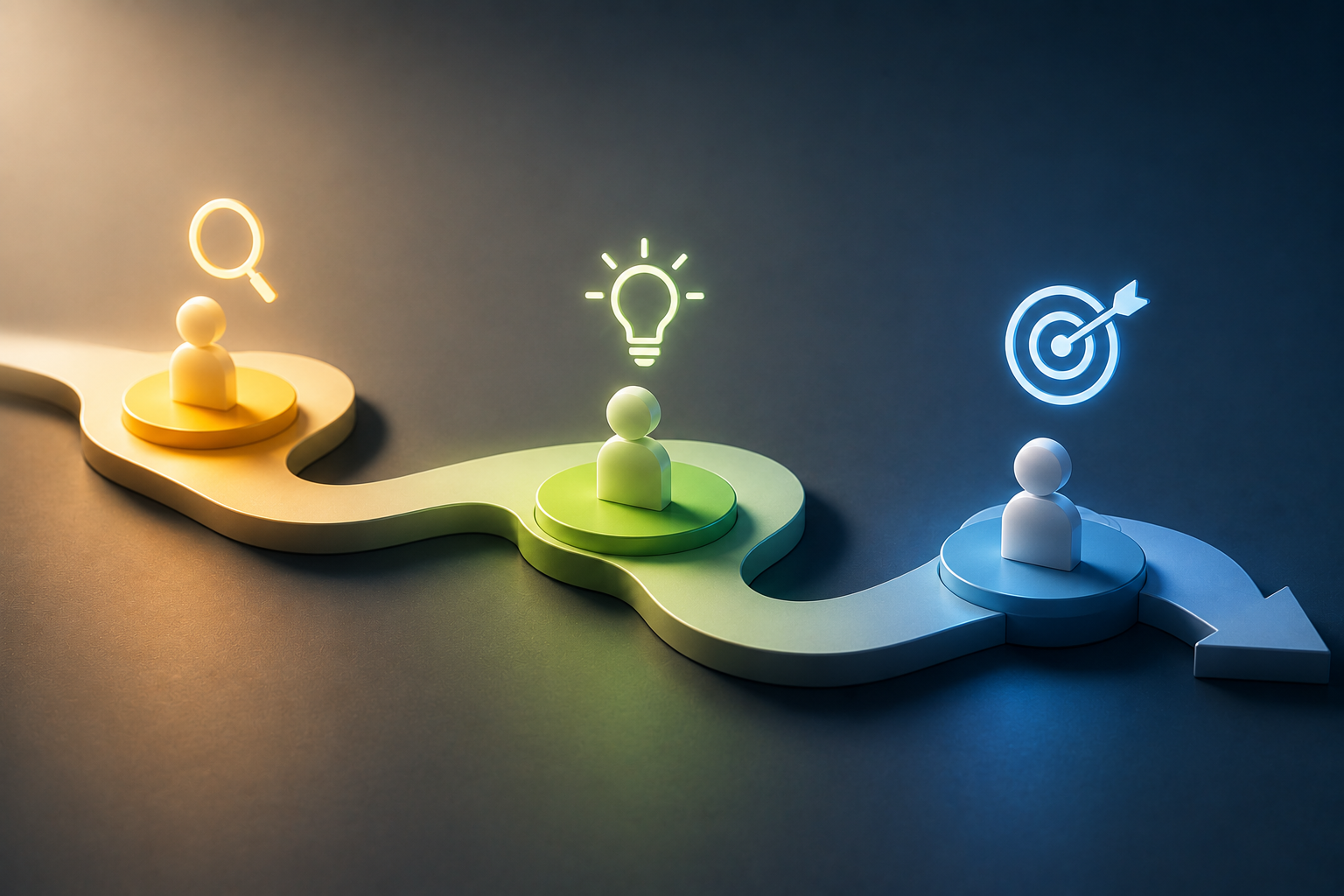
Although different companies use different terminology, most Buyer Journeys can be understood using three simple stages.
Stage 1: Awareness
Everything begins with a problem.
At this stage, buyers realize something isn't working as expected.
For example:
A marketing team notices that website traffic has stopped growing.
An HR department struggles with manual employee onboarding.
An IT team discovers increasing cybersecurity risks.
The buyer knows there's a challenge.
But they may not know the best way to solve it yet.
This is when they begin learning.
They might:
-
Read blog articles.
-
Watch educational videos.
-
Listen to podcasts.
-
Search Google.
-
Attend webinars.
-
Follow industry experts.
Notice something important.
They're not looking for products yet.
They're trying to understand the problem itself.
This is why educational content is so valuable during the Awareness stage.
Stage 2: Consideration
Now the buyer clearly understands the problem.
The next question becomes:
"What are my options?"
They begin exploring different ways to solve it.
For example:
If a company wants to improve customer support, they might compare:
-
Hiring more agents.
-
Using AI chatbots.
-
Purchasing customer service software.
-
Outsourcing support.
They're evaluating different approaches—not necessarily different vendors yet.
They continue researching through:
-
Whitepapers.
-
Industry reports.
-
Product comparisons.
-
Expert webinars.
-
Case studies.
-
Customer reviews.
At this stage, buyers want detailed information that helps them make informed decisions.
Stage 3: Decision
Once buyers know which type of solution they want, they begin comparing specific companies.
Now they're asking questions like:
-
Which vendor is most reliable?
-
Which solution offers the best value?
-
What do existing customers say?
-
How quickly can it be implemented?
-
Does it integrate with our existing systems?
-
What kind of support is included?
This is where businesses often provide:
-
Product demonstrations.
-
Free trials.
-
Pricing discussions.
-
Technical documentation.
-
Customer references.
-
ROI calculators.
The goal is to help buyers feel confident in their final decision.
Let's Understand This with a Real Example
Imagine you're the Marketing Manager at a software company.
One day, you notice that very few people are downloading your whitepapers.
You begin researching why.
At first, you search:
"Why are my content downloads low?"
That's the Awareness stage.
After reading several articles, you realize your landing pages may not be optimized.
Now you search:
"Best landing page optimization strategies."
That's the Consideration stage.
Later, you decide to purchase landing page optimization software.
You compare three vendors.
Book product demos.
Read customer reviews.
Review pricing.
Finally, you choose one.
That's the Decision stage.
Notice how your questions changed throughout the journey.
That's exactly what happens with every B2B buyer.
The Buyer Journey Isn't Always Linear
One of the biggest misconceptions in B2B marketing is that buyers move neatly from one stage to the next.
Real life doesn't work that way.
Someone might:
-
Read an article today.
-
Forget about the problem for three months.
-
Return after attending an industry event.
-
Download a research report.
-
Pause the project because budgets change.
Keep Reading
You've reached the end of your free preview. Create a free account to read the rest of this article and unlock the full B2Bmedium library.